Spain's Public BIM Mandate: A Contractor Guide
Spain's BIM mandate for public works (Order PCM/818/2023): thresholds, 2024-2030 timeline, mandatory IFC and how to document progress.
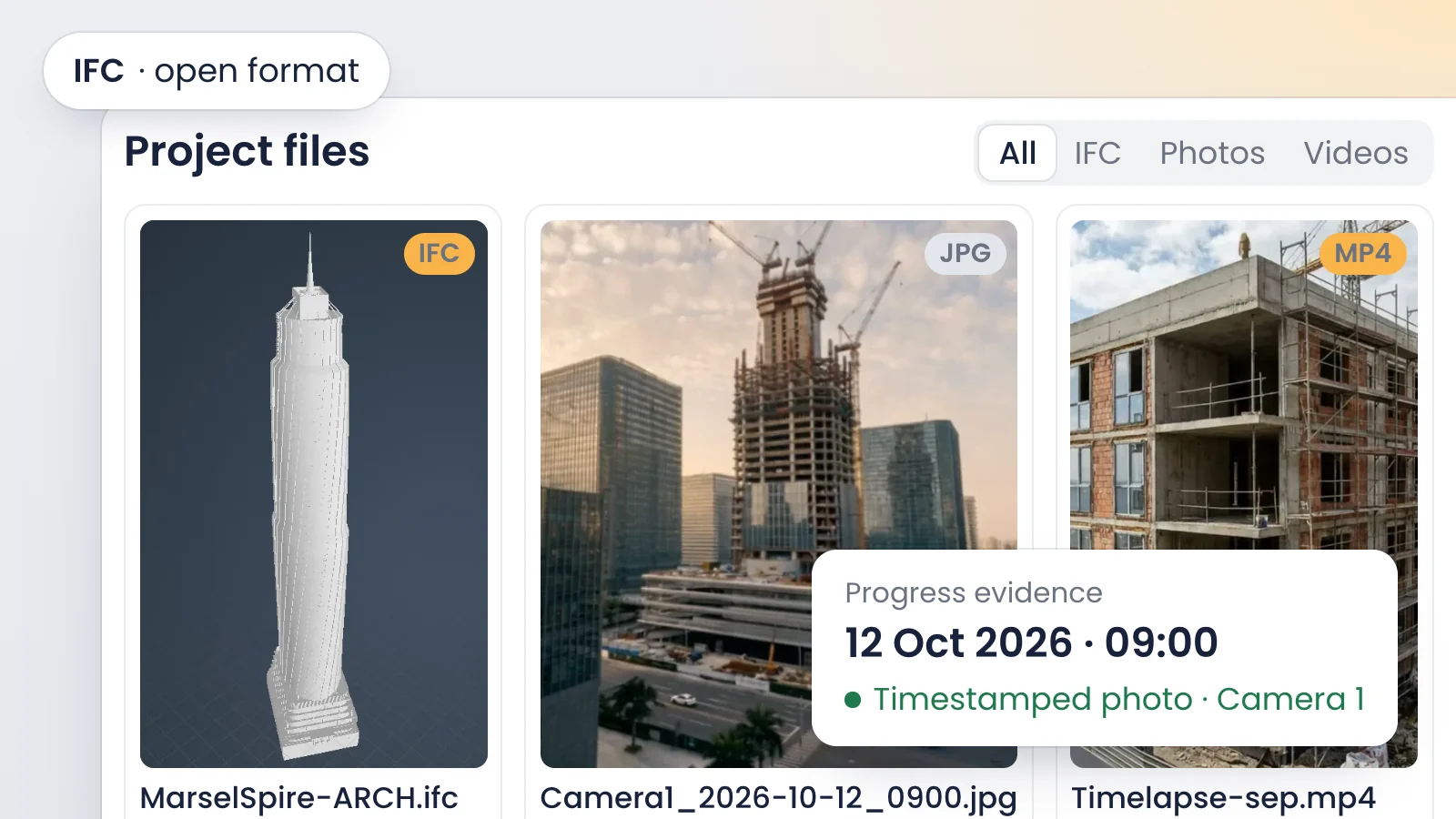
AI-generated images
Spain's public-sector BIM mandate, set by Order PCM/818/2023, requires central government contracting bodies to ask for BIM on works contracts with an estimated value of €2,000,000 or more, with maturity levels rising from 2024 to 2030 and IFC deliverables. If you bid on Spanish public works, it also raises a practical question: how you prove progress against the model.
What the Spanish BIM Plan is and who it binds
Spanish BIM Plan: a phased schedule approved by the Council of Ministers on 27 June 2023 and published in Spain's Official State Gazette (BOE) as Order PCM/818/2023. It sets when, and at what level, central government contracting bodies must require BIM on works contracts and related services.
The Plan works as an internal instruction, and its reach is specific. For a contractor coming from abroad, the key is who the client is:
- Mandatory for contracting bodies of the Spanish central government (Administración General del Estado) and the public bodies and agencies attached to it.
- Recommended for the rest of the state-level public sector, such as state-owned companies, public foundations, consortia and independent authorities.
- Out of scope: regional governments, municipalities and private owners. They are free to write their own BIM requirements into tender documents, and some do.
The contractor feels it first, because the requirements arrive in the tender documents and you must meet them to bid. But the contracting body feels it too: someone has to review what gets delivered.
Thresholds and timeline: which level applies when
The required level depends on the contract's estimated value, excluding VAT, and on the date the procurement procedure starts. This is the Plan's schedule:
Estimated value | From 1 Apr 2024 | From 1 Oct 2025 | From 1 Oct 2027 | From 1 Apr 2030 |
|---|---|---|---|---|
Upper threshold or above | Initial | Medium | Advanced | Integrated |
€2,000,000 to upper threshold | Initial (recommended) | Initial | Medium | Advanced |
Below €2,000,000 | Not required | Not required | Not required | Not required |
The upper threshold needs a word of explanation. The 2023 Order sets it at €5,382,000, but the Plan ties it to the threshold above which Spanish works contracts fall under EU-harmonized procurement rules (article 20 of Spain's Public Sector Contracts Act). That figure follows the EU thresholds, which are revised every two years. Under Commission Delegated Regulation (EU) 2025/2152, it stands at €5,404,000 from 1 January 2026.
In practice, a €3 million central government contract now calls for the initial level, and a €6 million one for the medium level. The five maturity levels run from "previous" (no BIM) through initial, medium, advanced and integrated, and they escalate requirements across strategy, processes, technology and people. A contracting body can skip BIM only as a justified exception, for instance urgency or a restriction on competition. On contracts of €12 million or more, that justification also goes to CIBIM, the interministerial commission that drives the Plan.
Which contracts are covered, beyond construction itself
The Plan doesn't stop at the construction contract. It covers works contracts and works concessions, service concessions that include works, mixed contracts, framework agreements and design contests. It also reaches the services tied to a covered project: design, site supervision (the dirección facultativa, roughly the architect or engineer of record on site), technical assistance and health and safety coordination.
That matters to international engineering firms and owner's rep consultancies. If the works contract crosses the threshold, the services contract that supervises it falls under the same schedule.
Mandatory IFC: what it means for your deliverables
The Plan is built on open formats. Graphical information and its linked data are exchanged using the IFC data model as defined in ISO 16739 (adopted in Spain as UNE-EN ISO 16739). BCF, for model issue tracking, and COBie, for structured asset information, appear as options. The contracting body can also ask for native files from your authoring tool.
Exporting to IFC does not guarantee a good IFC, and a rejected deliverable costs time on a schedule you don't control. Before you submit, open the file in a free online IFC viewer and check that storeys, element classes and the properties required by the tender are in the model.
What the mandate doesn't require, and you should have anyway: visual evidence of progress
The Plan governs the model and how it is exchanged. It sets no requirement for a visual record of the works or photographic control of construction. The advanced and integrated levels do call for construction simulations tied to the schedule, what the industry calls 4D, but proving that what was built matches what was modeled is left to each team.
That gap shows up at specific moments: the monthly progress certification, a change order, a delay claim, final acceptance. Each time the question is the same: what had been built on a given date, and did it match the model? A random photo on someone's phone answers that poorly. A continuous, dated record taken from the same viewpoint answers it well, and it does so in a language every party understands, whatever their native one.
How to document progress against the model
With a visual monitoring platform, each contract need has a concrete source of evidence:
Need | VisionHub tool | Evidence it leaves |
|---|---|---|
See the site without traveling | Live 4G fixed cameras | Current view and unlimited snapshots |
Reconstruct an incident | Continuous recording | Up to 30 days of downloadable HD video |
Summarize months of work | Time-lapse | Video by week, month or whole project |
Certify completed work | Photo comparison | Same view on two dates |
Check against the model | BIM digital twin | Live camera synced with the IFC |
Justify weather days | Weather | Alert with a jobsite image attached |
The piece that links the BIM mandate to the jobsite is the BIM digital twin module: load the contract IFC, sync its virtual camera with a site camera, and compare model and real image overlaid or side by side. Photo comparison completes the record with the same view on two dates, filtered by day, time and camera.
For a foreign contractor, this also solves a distance problem. Your home office, your Spanish joint venture partner and the client's supervision team can all see the same dated images, each with their own login and permissions, without waiting for a site visit.
An example. A joint venture builds a road section for a central government agency. It places fixed cameras on the two main work fronts and on an overpass, loads the overpass IFC, and schedules monthly drone flights with specialist partners. Each progress certification is backed by dated captures from the same viewpoint and by the comparison with the model, and the client's site supervisor reviews the same material from their office.
Transparency on public works: what the client gains
For public owners, a visual record is not only about control; it is accountability. Practices that fit the Plan:
- Give the contracting body's technical staff, the site supervisor and technical assistance separate permissions. VisionHub has no cap on users per project.
- Publish images or time-lapses on a public transparency portal through an embeddable iframe from the media gallery.
- Apply privacy masks to cameras to comply with GDPR when the frame includes public streets or homes.
- Keep the dated record with the model for final acceptance and the operation phase.
See the use cases by client type, including public agencies, in our profiles section.
Frequently asked questions
Is BIM mandatory on all public works in Spain?
No. The Plan binds the Spanish central government and its attached public bodies, on contracts with an estimated value of €2,000,000 or more, excluding VAT. For the rest of the state-level public sector it is a recommendation. Regional governments and municipalities fall outside this Plan, although they can require BIM in their own tender documents.
What is the upper threshold in 2026?
€5,404,000 from 1 January 2026. The Plan ties its upper threshold to the EU-harmonized threshold for works in Spain's Public Sector Contracts Act, which follows EU procurement thresholds. Delegated Regulation (EU) 2025/2152 set that figure for 2026 and 2027, replacing the €5,382,000 printed in the 2023 Order.
Is IFC delivery mandatory?
Yes, on contracts covered by the Plan. Model information is exchanged in IFC according to ISO 16739, adopted in Spain as UNE-EN ISO 16739. BCF and COBie can be requested as options, and the contracting body may also ask for native files. Check every IFC in a viewer before you submit it.
Does the BIM Plan require jobsite cameras or progress photos?
No. The Plan regulates the model, its exchange and the maturity levels, but it does not impose a visual record of construction. Even so, dated images compared with the model are the most direct way to support progress certifications, change orders and time extensions, and they deliver the transparency expected on public works.
Conclusion
Spain's BIM Plan already requires the initial level on central government contracts of €2 million or more, and raises the bar in phases through 2030. Compliance means delivering a sound IFC. Winning and running the job well means being able to show, with a date and from the same viewpoint, that construction is following the model. If you are bidding on or supervising Spanish public works and want to set up that record, book a demo. For the wider context on models and site captures, read our guide to the construction digital twin.